Understanding the "official language" of India can be a bit like trying to navigate a colorful, bustling bazaar—it’s diverse, multi-layered, and carries a lot of history. A common misconception is that India has a single "National Language." In reality, the framework is much more inclusive.
Here is a blog post breaking down the linguistic tapestry of India as of 2026.
The Linguistic Mosaic: Understanding India’s Official Languages
If you’ve ever walked through an Indian railway station, you’ve likely seen signs in at least three different scripts. This isn't just for aesthetic flair—it is a reflection of one of the most complex and democratic linguistic policies in the world.
To clear up the most common question first: India does not have one single "National Language." Instead, it uses a unique system of "Official Languages" to balance its immense regional diversity.
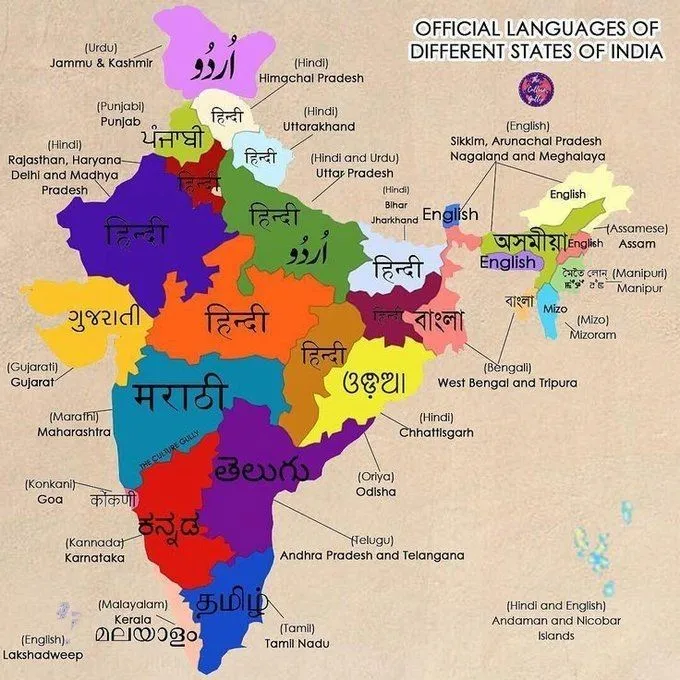
1. The Union Duo: Hindi and English
Under Article 343 of the Indian Constitution, the official language of the Union (the central government) is Hindi in the Devanagari script.
However, the transition away from English—originally intended to be a temporary measure for 15 years after independence—never fully happened. Through the Official Languages Act of 1963, English continues to be used for all official purposes of the Union, parliamentary proceedings, and central legislation. Essentially, the Union operates in a bilingual mode.
2. The Eighth Schedule: The Elite 22
While Hindi and English handle the central administration, the Constitution recognizes the importance of regional identities through the Eighth Schedule. This is a list of languages that enjoy official status and government encouragement.
As of 2026, there are 22 scheduled languages:
The Originals (14): Assamese, Bengali, Gujarati, Hindi, Kannada, Kashmiri, Malayalam, Marathi, Odia, Punjabi, Sanskrit, Tamil, Telugu, and Urdu.
Later Additions: Sindhi (added 1967); Konkani, Manipuri, and Nepali (1992); Bodo, Dogri, Maithili, and Santhali (2003).
Did you know? Being on this list means a language can be used by candidates for Union civil service examinations and that the government is tasked with enriching these languages.
3. The "Classical" Elite
In recent years, the Indian government has also conferred the status of "Classical Language" on certain tongues with high antiquity and a rich, original literary tradition. By late 2024 and into 2025/26, this list expanded significantly to include 11 languages:
Tamil, Sanskrit, Kannada, Telugu, Malayalam, and Odia.
The New Entrants: Marathi, Pali, Prakrit, Assamese, and Bengali.
4. Why This Matters
This "Polyglot Policy" is India’s way of saying that unity doesn't require uniformity.
States' Rights: Each state has the power to legislate its own official language(s) for local administration. For example, while the Union uses Hindi/English, the state of Karnataka uses Kannada.
Digital Inclusivity: In 2026, this diversity is moving into the tech space. The government has prioritized making the Constitution and legal glossaries available in various regional languages (like the recent 2026 releases in Gujarati and Tamil) to ensure justice is accessible in one’s mother tongue.
Final Thoughts
India’s linguistic policy is a living, breathing entity. It respects the ancient roots of Sanskrit and Pali while embracing the global utility of English and the widespread reach of Hindi. It is a reminder that in a land of over 1.4 billion people, your "mother tongue" isn't just a way to speak—it’s a constitutional right.