In industrial manufacturing and processing environments where grinding, cutting, woodworking, mining, cement production, agricultural processing, metal fabrication, powder handling, and bulk material transfer operations generate airborne dust and particulate contaminants, selecting the right dust collection system is essential for maintaining workplace air quality, improving operational efficiency, protecting worker health, and ensuring reliable industrial pollution control performance, and since different industries produce varying dust characteristics, airflow capacities, operational conditions, and production requirements, choosing a suitable cyclone dust collector requires careful evaluation of technical, operational, and environmental factors to ensure efficient long-term dust separation performance, and while cyclone dust collectors provide highly effective mechanical dust separation through centrifugal airflow technology, improper system selection can result in poor dust collection efficiency, airflow imbalance, excessive wear, increased operational costs, and reduced industrial performance, and in the middle of planning an efficient industrial dust control solution, the Cyclone Dust Collector should be selected after carefully considering factors such as airflow capacity, dust particle characteristics, cyclone size, material construction, operational conditions, and maintenance requirements to ensure reliable long-term dust separation efficiency and industrial pollution control performance.
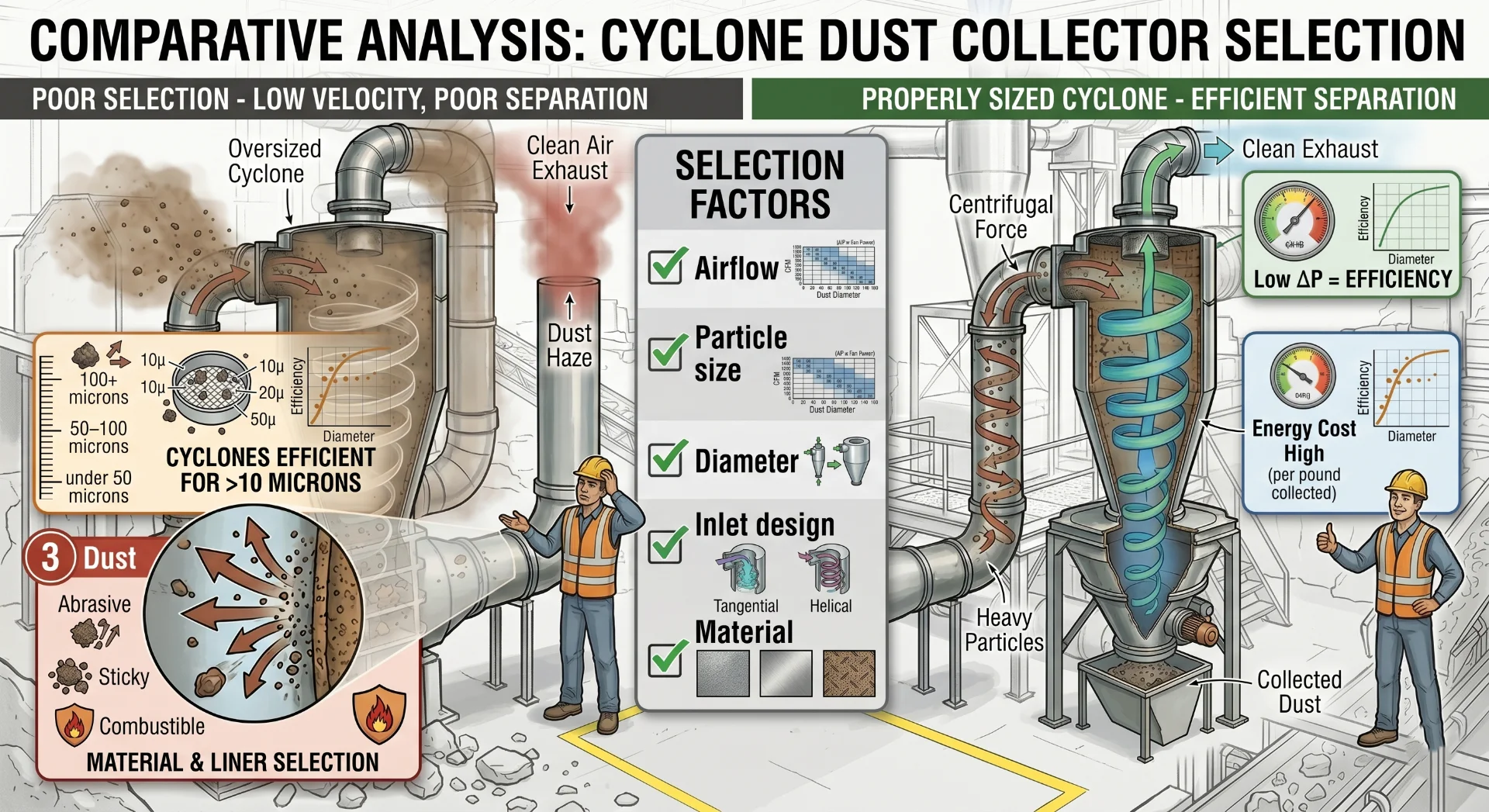
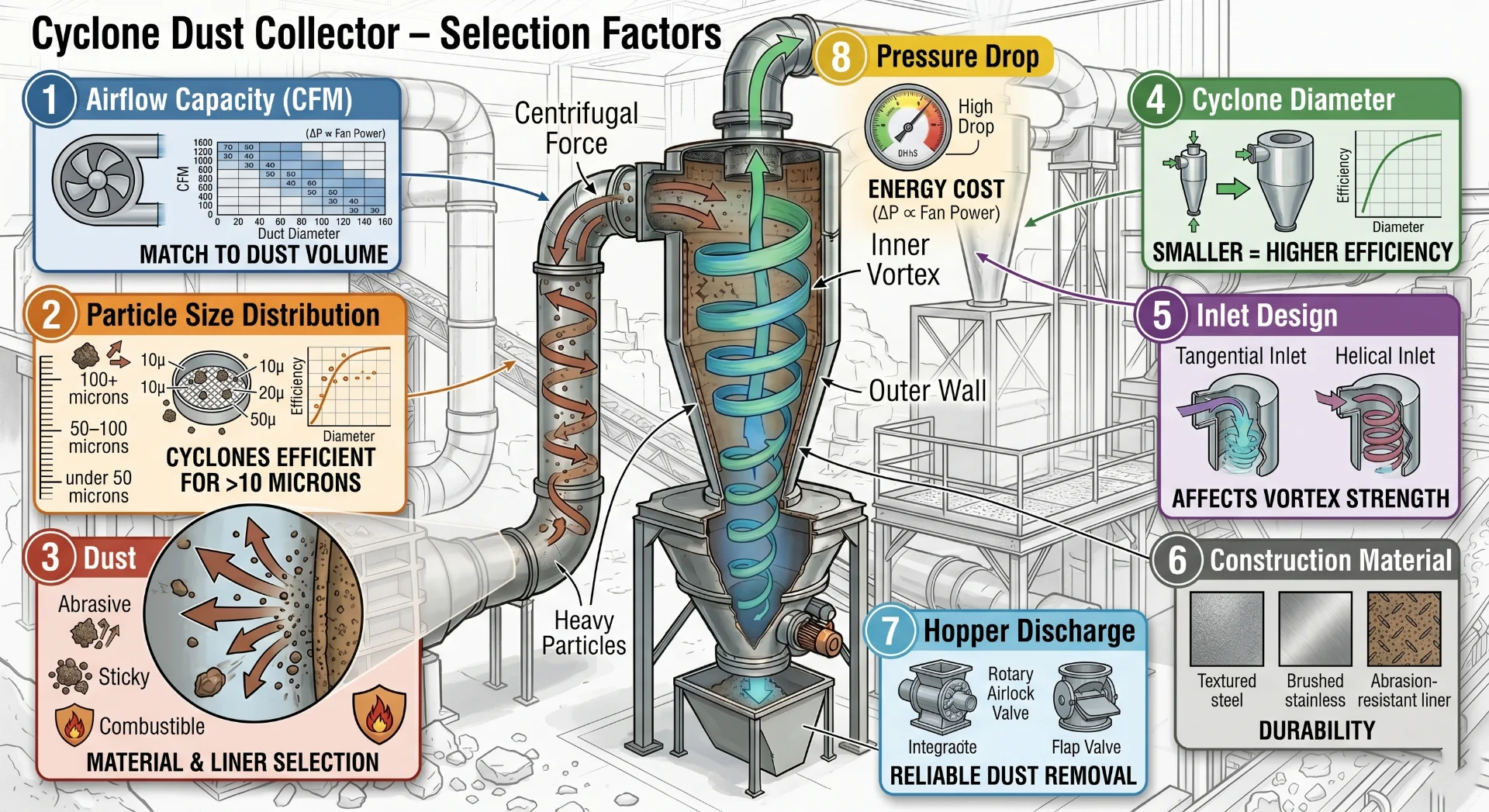
One of the most important factors to consider before selecting a cyclone dust collector is the type and characteristics of dust generated during industrial operations. Different industries produce different particulate materials such as sawdust, grinding particles, cement dust, metal chips, powder residue, agricultural contaminants, or abrasive particulate matter, and each type of dust may require specific cyclone design arrangements for efficient separation. Particle size is another major consideration because cyclone dust collectors are more effective for separating larger and medium-sized dust particles compared to extremely fine particulate matter. Industries handling fine airborne particles may require secondary filtration systems such as pulse jet bag filters or cartridge filters in combination with cyclone collectors. Airflow capacity is also extremely important because the cyclone dust collector must handle the total volume of contaminated air generated during industrial production operations. Improper airflow selection can reduce centrifugal force and lower dust separation efficiency. Cyclone diameter and inlet design directly affect airflow velocity and centrifugal force generation inside the collector chamber. Smaller cyclone diameters generally produce stronger centrifugal force and improved fine particle separation, while larger cyclone systems are suitable for handling higher airflow capacities and heavy industrial dust loads. Dust density and material weight should also be evaluated carefully because heavier particles separate more efficiently under centrifugal force than lightweight contaminants. Operational temperature is another important factor because certain industrial processes generate high-temperature airflow that may require heat-resistant construction materials and specialized cyclone designs. Abrasive dust particles such as cement residue, metal particles, and mineral dust may cause internal wear inside the cyclone chamber, making abrasion-resistant liners and heavy-duty steel construction important for long-term operational durability. Moisture levels and humidity conditions should also be considered because wet or sticky dust particles may reduce dust discharge efficiency and create material build-up inside the cyclone hopper. Dust collection hopper design and discharge arrangements are important because collected dust must be removed continuously without interrupting airflow performance. Rotary airlocks and automated discharge systems may improve dust handling efficiency during continuous industrial operation. Energy efficiency is another major consideration because airflow resistance and fan power consumption directly affect operational costs during long-term industrial use. Proper airflow balancing and optimized cyclone design help maintain efficient operation with lower energy consumption. Installation space and production layout should also be reviewed carefully before selecting cyclone size and configuration. Compact multi-cyclone arrangements may be preferred for industries with limited installation space. Maintenance accessibility is another important factor because hopper cleaning, airflow inspection, wear monitoring, and duct servicing are necessary for maintaining reliable long-term dust separation performance. Industries should also consider future production expansion and changing airflow requirements during system selection. Industrial safety requirements are critical, especially in operations involving combustible dust, sparks, hot particles, or explosive contaminants. Certain applications may require spark arrestors, explosion protection systems, anti-static arrangements, and industrial safety monitoring controls. Advanced cyclone dust collectors may include multi-cyclone designs, abrasion-resistant liners, automated dust discharge systems, airflow balancing controls, and integrated pre-cleaner arrangements for improved operational efficiency. Proper maintenance planning including hopper cleaning, airflow monitoring, wear inspection, and duct servicing should be included during system selection to ensure reliable long-term performance. In the final paragraph, the Cyclone Dust Collector should be selected after carefully evaluating factors such as airflow capacity, dust particle size, cyclone diameter, operational temperature, abrasive material handling, construction quality, energy efficiency, maintenance accessibility, installation space, and industrial safety requirements to ensure efficient dust separation, cleaner workplace air quality, reliable operational performance, and long-term industrial pollution control efficiency.
Conclusion
Selecting the right cyclone dust collector requires careful consideration of airflow, dust characteristics, cyclone design, operational conditions, maintenance requirements, and industrial safety factors to ensure efficient dust separation, cleaner workplaces, safer working conditions, and reliable long-term industrial pollution control performance.