Industrial finishing, sanding, grinding, polishing, deburring, and surface preparation processes can generate significant amounts of airborne dust and fine particles. If these contaminants are not captured close to the point where they are produced, they can spread across the workshop, settle on machinery, affect finished components, and create an uncomfortable working environment. A Suction Wall System provides a practical source-capture solution by drawing contaminated air away from the operator and toward a controlled extraction surface. Instead of allowing dust to move freely through the production area, the system creates a defined airflow path that directs particles toward filtration and collection equipment. This approach is particularly useful when workers handle large or irregularly shaped components that cannot easily be placed inside a conventional enclosed booth. By combining an accessible working area with localized extraction, a properly engineered Suction Wall System can support cleaner production conditions, better housekeeping, improved operator comfort, and more controlled dust management. The actual benefits depend on correct airflow design, suitable filtration, appropriate equipment sizing, proper workpiece positioning, and regular maintenance.
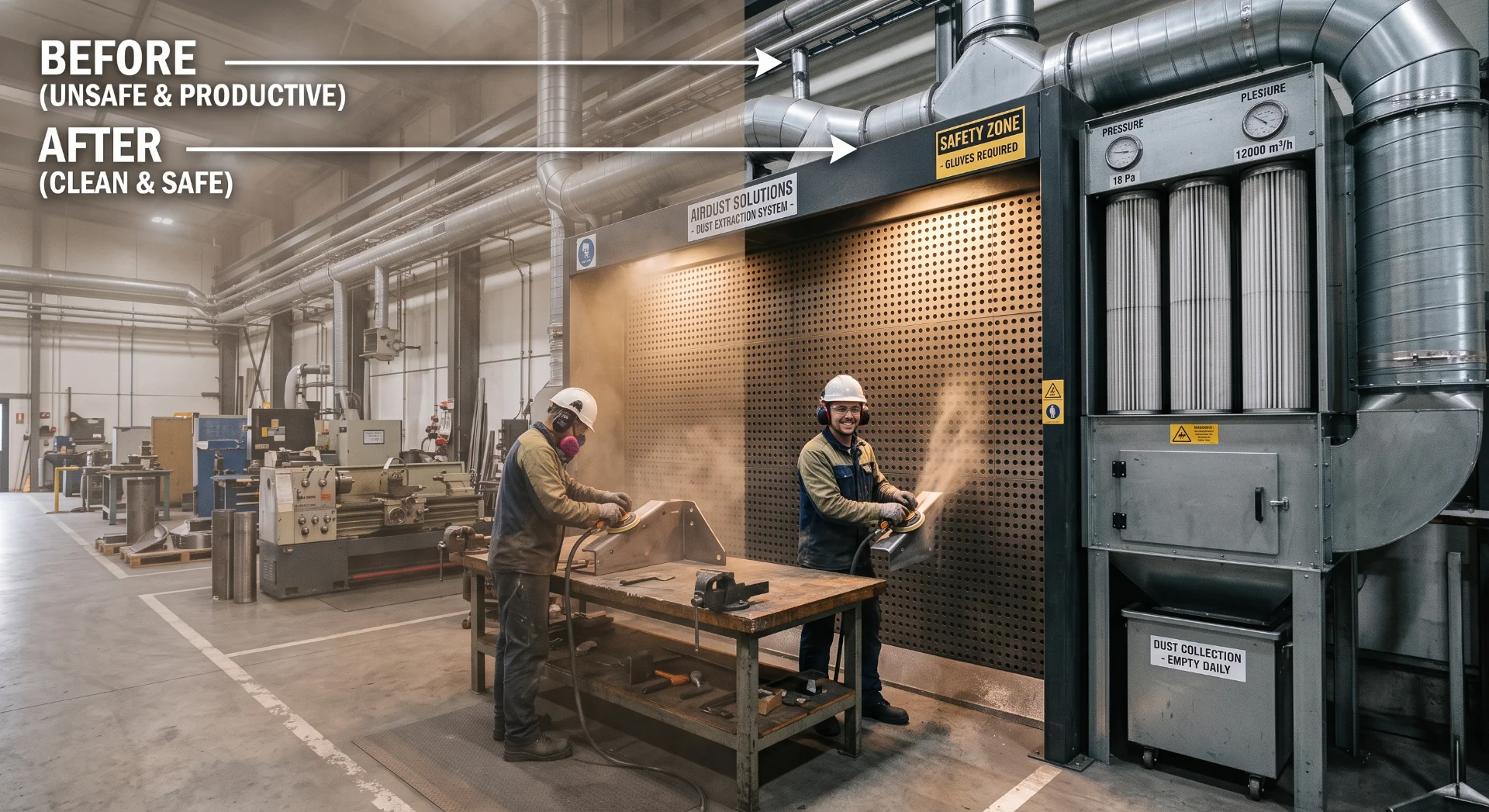
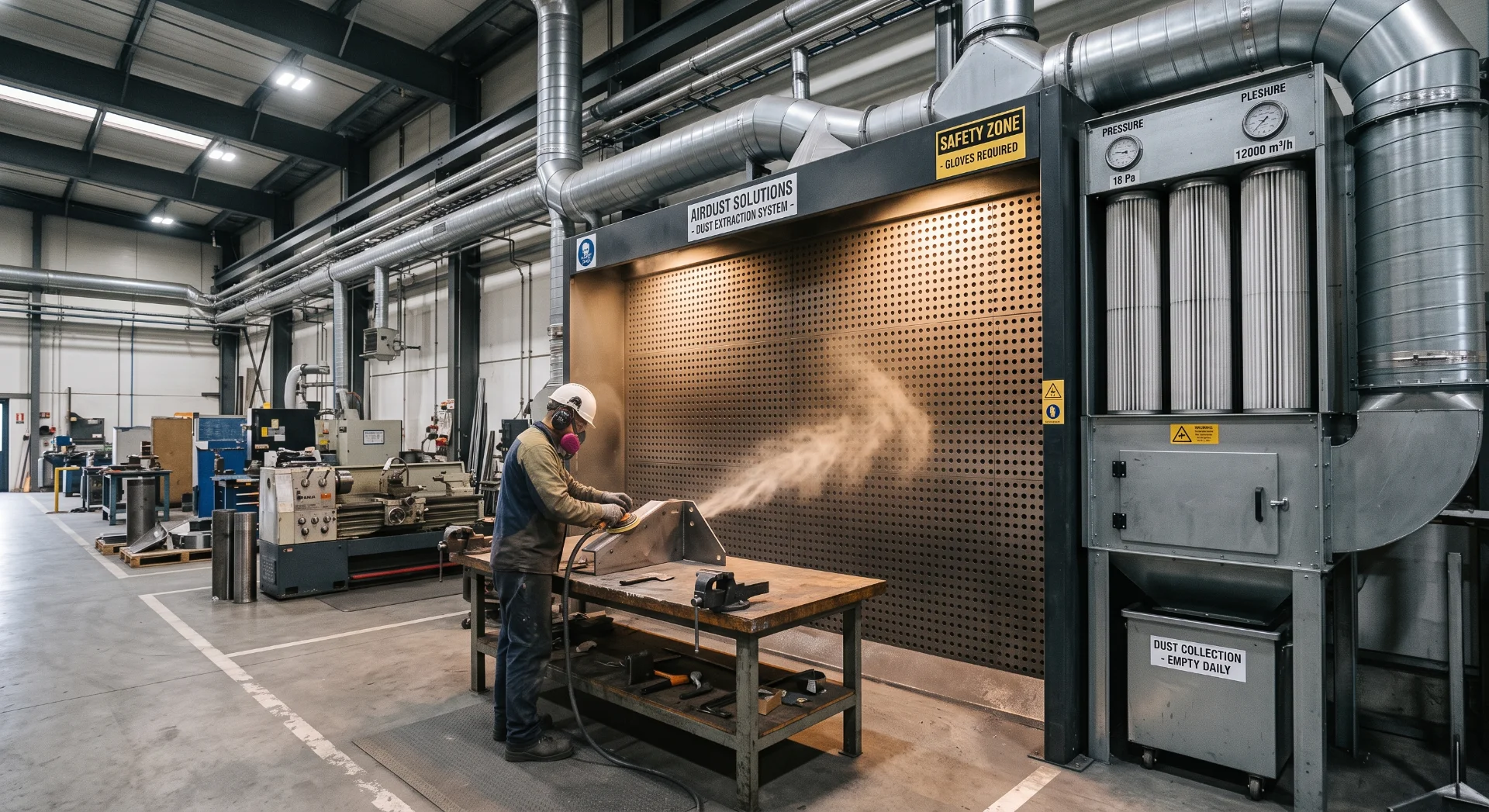
One of the most important benefits is source-level dust capture. Dust is easiest to control when it is captured close to the point where it is generated. Once particles spread throughout a workshop, controlling them becomes more difficult because they can move through the general air volume and settle on different surfaces. A suction wall creates a defined extraction zone behind or adjacent to the work area. When the operator performs sanding or grinding in front of the wall, contaminated air is pulled toward the extraction surface. This reduces the opportunity for dust to travel into the surrounding workplace. Source capture can therefore be more effective than relying only on general ventilation because the extraction system acts directly on the process that produces the contaminant.
The reduction of airborne dust can contribute to a cleaner working environment. Industrial dust can settle on floors, workbenches, machines, tools, electrical components, storage areas, and finished products. Accumulation can increase housekeeping requirements and may interfere with other production activities. When dust is captured continuously at the workstation, less material is allowed to escape into the wider factory area. This can reduce secondary contamination and make routine cleaning more manageable. The benefit is especially noticeable in operations that generate fine dust continuously throughout a production shift. Instead of allowing the dust to accumulate and cleaning the area later, extraction provides continuous control during the actual process.
A cleaner workplace can also support better operator comfort. Workers performing manual sanding, grinding, or polishing may spend several hours close to the point where dust is generated. If airborne particles remain around the operator, the working environment can become unpleasant and visibility may be reduced. Effective extraction removes contaminated air from the immediate work zone and helps maintain a cleaner atmosphere around the workstation. The system should not be considered a substitute for all other required protective measures, but it can serve as an important engineering control within a broader workplace safety strategy. Appropriate personal protective equipment and operating procedures should still be used according to the material and process.
Another important advantage is improved visibility during finishing operations. Fine dust can form a visible haze around sanding and grinding work, particularly when production rates are high. This can make it harder for operators to inspect the surface being processed. Good source extraction can reduce airborne dust around the workpiece and help maintain clearer visibility. Better visibility can support more controlled manual work because the operator can see the surface condition more easily. This can be especially useful during finishing processes where surface uniformity is important.
A suction wall can also help protect machinery and surrounding equipment from unnecessary dust exposure. Fine particulate matter can enter moving components, ventilation openings, electrical enclosures, motors, control panels, and other equipment if it remains airborne for long periods. Excessive dust accumulation can increase maintenance requirements and may reduce equipment reliability over time. Capturing the dust at the source reduces the amount available to migrate through the production area. This does not eliminate the need for routine machine cleaning and maintenance, but it can reduce the overall dust burden within the workshop.
Product quality is another area where effective dust extraction can provide value. Sanding and grinding are often preparation stages before painting, powder coating, bonding, polishing, or another finishing process. If dust settles on a prepared surface, it can become a source of contamination. This may affect the appearance or consistency of subsequent finishing operations. By controlling airborne particles around the preparation workstation, a suction wall can help maintain a cleaner surface preparation environment. The extraction system alone cannot guarantee final product quality because many other process variables are involved, but effective dust control can reduce one common source of contamination.
The system can also help reduce the time spent on repeated cleaning. Without local extraction, dust generated during manual finishing may spread over a large section of the workshop. Cleaning then requires operators to remove dust from floors, walls, machinery, worktables, tools, and other surfaces. Continuous source extraction limits the amount of material entering the wider environment. This can make housekeeping more focused and efficient. Over a long production period, reduced cleaning requirements can contribute to better use of labor because workers can spend more time on productive activities rather than repeated dust removal.
Large workpieces are another area where suction wall systems can offer practical advantages. Conventional enclosed booths may not always be convenient when operators need to process large panels, fabricated structures, vehicle components, furniture parts, machinery housings, or other oversized products. A suction wall provides an open working face, allowing the operator to move the component in front of the extraction surface. This flexibility can make manual finishing easier while still providing localized dust control. The wall can be designed with a suitable width and height so that the extraction zone covers the typical dimensions of the workpieces handled by the facility.
The open workstation arrangement can also improve material handling. Operators may be able to position components using carts, tables, lifting devices, or other handling equipment without passing through a narrow enclosed booth opening. This can simplify workflow for operations involving frequent loading and unloading. However, the workstation layout must still provide sufficient space for safe movement, access, and maintenance. The extraction wall should be integrated into the factory layout rather than installed without considering how materials and people move around it.
A properly designed suction wall can also support flexible production. Different components may require different finishing processes, and the operator may need to move around the workpiece during sanding or grinding. The extraction system should provide a useful capture zone across the working area rather than concentrating airflow in only one small location. Balanced airflow distribution is therefore important. The design of the suction surface, internal plenum, fan, ductwork, and filtration system should work together to maintain suitable extraction throughout the intended workstation.
The filtration arrangement has a direct influence on the practical benefits of the system. Dust captured by the suction wall must be separated from the extracted air before the air is discharged or otherwise managed. Filter selection depends on particle size, dust concentration, material properties, operating conditions, and the required filtration performance. Coarse particles may be separated before the main filter stage, while finer particles can be captured by cartridge or bag filtration. For applications involving particularly fine or sensitive contaminants, additional filtration may be considered based on the process requirements. The objective is to provide reliable particulate control without creating excessive resistance to airflow.
Filter loading is an important operational consideration. As dust accumulates on filter surfaces, airflow resistance can increase. If this is not managed, extraction performance may gradually decline. Depending on the equipment design, filters may be cleaned through pulse-jet air, mechanical vibration, manual cleaning, or another suitable method. Maintaining the filter in good condition helps preserve airflow and reduces unnecessary pressure loss. Operators should monitor system performance and respond to changes in airflow, pressure, or filter condition rather than waiting until extraction becomes noticeably weak.
The extraction fan is equally important. A suction wall cannot provide effective dust control if the fan does not deliver sufficient airflow against the resistance of the system. Fan selection should consider the wall design, filters, ductwork, dampers, bends, and other components that contribute to pressure loss. A fan that is too small may produce inadequate capture. An unnecessarily large fan may consume more energy than required. Proper engineering aims to achieve the required extraction performance while keeping energy use reasonable. This makes complete system design more important than selecting equipment only according to motor power.
Energy efficiency can become a significant benefit when the system is correctly matched to the production process. The extraction fan consumes electricity whenever it operates. If the system continuously moves much more air than necessary, operating costs can increase. Suitable airflow control, efficient fan selection, variable-speed operation where appropriate, and proper filter maintenance can help maintain efficient operation. Keeping ducts clean and ensuring that extraction paths remain unrestricted can also prevent unnecessary pressure losses. Energy performance should therefore be considered during both initial design and long-term maintenance.
A suction wall can also contribute to better factory organization. Establishing a dedicated finishing workstation gives operators a defined area for sanding, grinding, polishing, or related activities. This can help separate dusty processes from cleaner production areas. Keeping dust-generating work within a designated extraction zone can make the overall plant layout easier to manage. It can also reduce the chance that airborne dust from one process will interfere with another operation. This is particularly valuable in facilities where surface preparation and painting or coating are performed in nearby areas.
Noise control is another practical consideration. Fans and blowers generate sound, and airflow through filters and ductwork can contribute to the overall noise level. A well-designed system should consider the acoustic environment of the workstation. Proper equipment mounting, suitable fan selection, balanced airflow, and regular mechanical maintenance can help prevent unnecessary noise. Lower noise levels can make the workstation more comfortable and may encourage operators to use the extraction system consistently. If the system becomes excessively noisy because of a mechanical fault or blocked filter, the condition should be investigated rather than ignored.
Maintenance requirements are also influenced by the quality of the initial design. A system that provides easy access to filters, collection containers, fan components, inspection points, and duct connections is generally easier to maintain. Routine inspection can identify problems before they affect production. Filters should be checked for damage and excessive loading. Collection containers should be emptied at appropriate intervals. Fans and motors should be inspected for vibration, overheating, or unusual sounds. Ductwork should be checked for leaks or excessive deposits. These activities help preserve the extraction performance that the system was designed to provide.
The type of dust being collected has a major influence on safety. Wood dust, metal grinding dust, composite dust, mineral dust, coating residues, and other materials do not have identical characteristics. Some dusts may be combustible or explosive under specific conditions. Others may be toxic, corrosive, reactive, or abrasive. Before selecting a suction wall and filtration system, the material characteristics should be evaluated. Where combustible or hazardous dust is involved, the system may require additional protection measures and specialized engineering. The fact that a suction wall captures dust does not mean every dust type can be handled using the same equipment configuration.
Waste management is another benefit when the system is designed with suitable collection arrangements. Instead of allowing dust to spread throughout the workshop, captured material is directed toward a defined collection area. This makes it easier to inspect, remove, and manage the collected material. However, collected dust can retain the same hazardous characteristics as the original material. Safe handling procedures should therefore be established. The collection container should be suitable for the material, and workers should avoid creating additional airborne dust when emptying it. Disposal or recycling should be based on the material composition and applicable requirements.
A suction wall can also reduce the dependence on broad general ventilation for controlling process dust. General ventilation is useful for managing overall workplace air conditions, but it may not be sufficient to capture contaminants directly at the source. Local extraction works closer to the process. This allows the facility to target the specific workstation producing the dust. Combining local extraction with appropriate general ventilation can provide a more comprehensive approach to workplace air management. The exact arrangement should depend on the building, process, contaminant, and airflow requirements.
The system can support production efficiency by creating a more controlled working environment. When dust is continuously removed, operators may spend less time stopping production to clean the workstation. Components may require less repeated cleaning before downstream processes. Machinery may experience less dust accumulation. The production area can remain more organized. These improvements may seem small when viewed individually, but they can become significant over long production periods. Efficiency gains are strongest when the extraction system is integrated into the production workflow instead of being treated as a separate facility service.
Worker acceptance is also important. An extraction system must be practical for the operator to use. If the workpiece cannot be positioned comfortably, if the airflow interferes with the finishing process, or if the system creates excessive noise, workers may avoid using it correctly. A good design considers ergonomics as well as technical performance. The working height, wall dimensions, lighting, access, component handling, airflow direction, and operator movement should all be considered during planning. A system that fits naturally into the operator's workflow is more likely to deliver consistent performance.
The benefits become even more valuable when the system is properly commissioned. After installation, airflow should be checked under actual operating conditions. The extraction surface should be inspected to confirm that the working area receives appropriate airflow. Filter pressure and fan performance should be established as baseline values. Operators should understand normal operating conditions and know how to identify abnormal performance. Establishing these baseline conditions makes future maintenance easier because changes can be compared with the original operating values.
A facility should also consider future production requirements before selecting the system. If production volumes may increase, larger components may be introduced, or additional workstations may be added, the extraction arrangement should be capable of supporting realistic future needs. Modular construction can provide flexibility in some applications. However, oversizing the equipment unnecessarily can increase initial cost and energy consumption. The objective should be to provide sufficient capacity for the current process while allowing reasonable future expansion where practical.
Overall, the main advantage of a Suction Wall System is that it brings dust control directly into the workstation where the contaminant is generated. It can reduce airborne dust, support cleaner air around the operator, protect surrounding equipment, reduce secondary contamination, improve housekeeping, support surface preparation quality, and make large-component finishing more practical. These benefits become stronger when airflow, filtration, fan capacity, collection, workpiece positioning, and maintenance are designed as one complete system. For an industrial facility, the most effective approach is to evaluate the actual process, material, production volume, workpiece dimensions, dust characteristics, and operating environment before selecting equipment. When these factors are properly matched, a Suction Wall System can become a valuable part of industrial dust control by providing localized extraction, cleaner working conditions, improved production organization, and dependable contaminant management.
Conclusion
A suction wall can provide significant practical benefits for industrial operations that generate dust during sanding, grinding, polishing, deburring, and surface preparation. Its biggest advantage is source-level control. Instead of allowing dust to travel through the factory before it reaches a ventilation or filtration system, the contaminated air is directed toward the extraction surface close to the point of generation.
This localized approach can help reduce airborne dust around operators and limit the spread of particles across the workshop. It can also support cleaner machinery, better housekeeping, improved visibility, and more controlled surface preparation. When dust is managed continuously during production, the facility may spend less time dealing with secondary contamination and repeated cleaning.
The system can be particularly useful for large or irregularly shaped components because it provides an open working area while maintaining localized extraction. This can make manual finishing operations more flexible than arrangements that require complete enclosure. However, the workstation still needs to be designed around safe operator movement, workpiece handling, airflow distribution, and maintenance access.
Proper filtration and fan selection are essential for achieving these benefits. The system must provide sufficient airflow while avoiding unnecessary energy consumption. Filters must be selected according to the dust characteristics and maintained regularly. Collection containers must be suitable for the material being captured. Ductwork, fans, dampers, and extraction surfaces should all be considered as parts of one integrated system.
Safety must also remain a central consideration. Different dusts have different physical and chemical properties. Combustible, reactive, toxic, abrasive, or corrosive materials may require additional engineering controls. Therefore, the system should always be designed according to the actual process and material rather than based only on a standard equipment size.
When correctly designed, installed, operated, and maintained, a suction wall can improve dust management while supporting productivity, operator comfort, workplace cleanliness, and consistent industrial finishing operations. The best results come from treating dust extraction as an important part of the production process rather than simply as an additional machine installed beside it.