Surface preparation is a critical requirement across many industries because the quality of a product often depends on the condition of its surface before painting, coating, welding, assembly, or finishing. Rust, mill scale, corrosion, old coatings, and manufacturing residues can reduce product quality and shorten service life if not removed properly. To achieve clean, uniform, and properly prepared surfaces, industries around the world rely on Shot Blasting. This highly effective process is used in a wide range of sectors due to its ability to improve surface quality, enhance coating adhesion, increase productivity, and support long-term product durability.
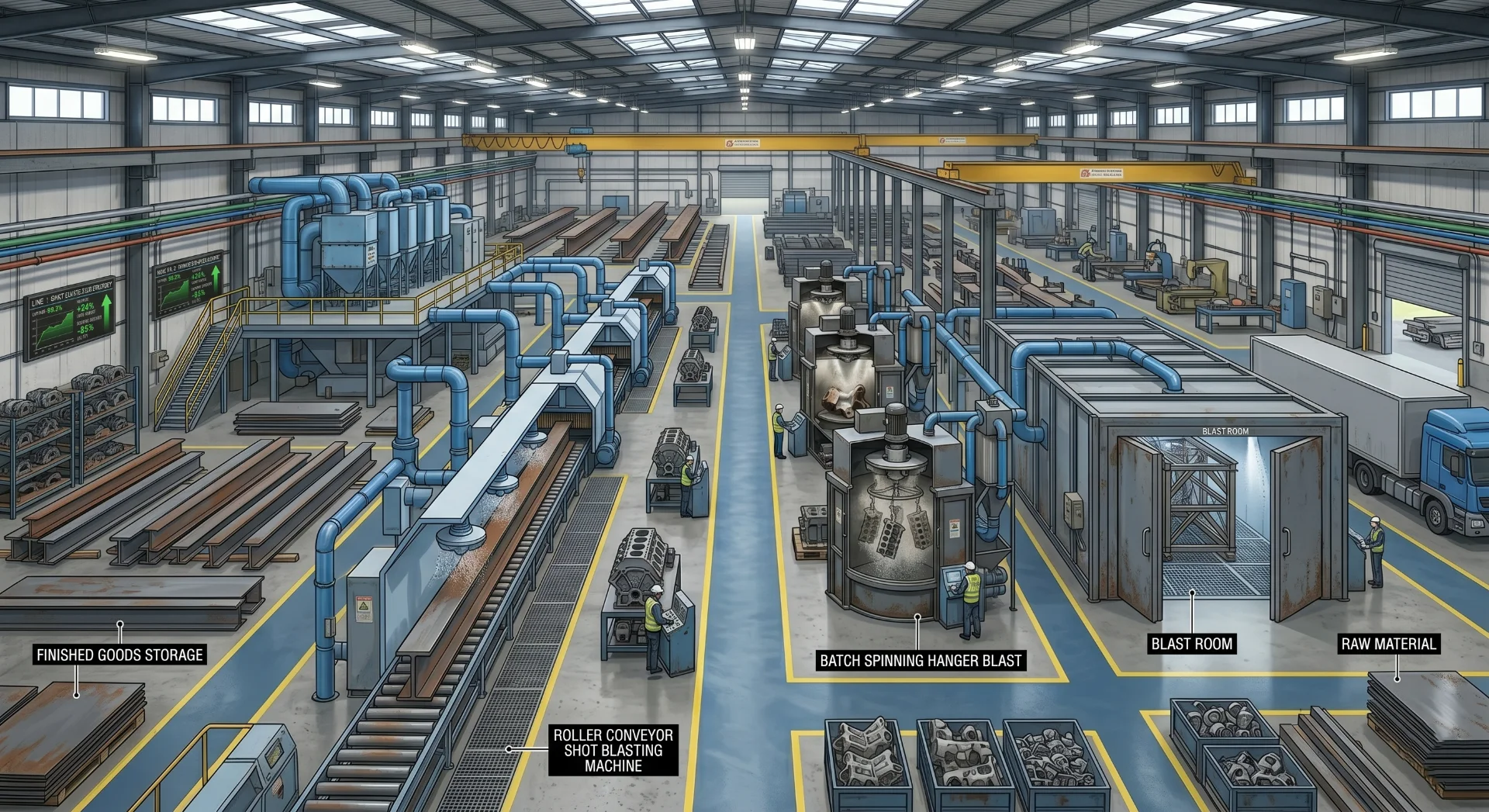
One of the largest users of shot blasting technology is the steel fabrication industry. Fabrication companies process steel plates, beams, channels, structural sections, and fabricated assemblies that require cleaning before painting or coating. Shot blasting removes mill scale, rust, and surface contaminants, creating an ideal surface for protective finishes.
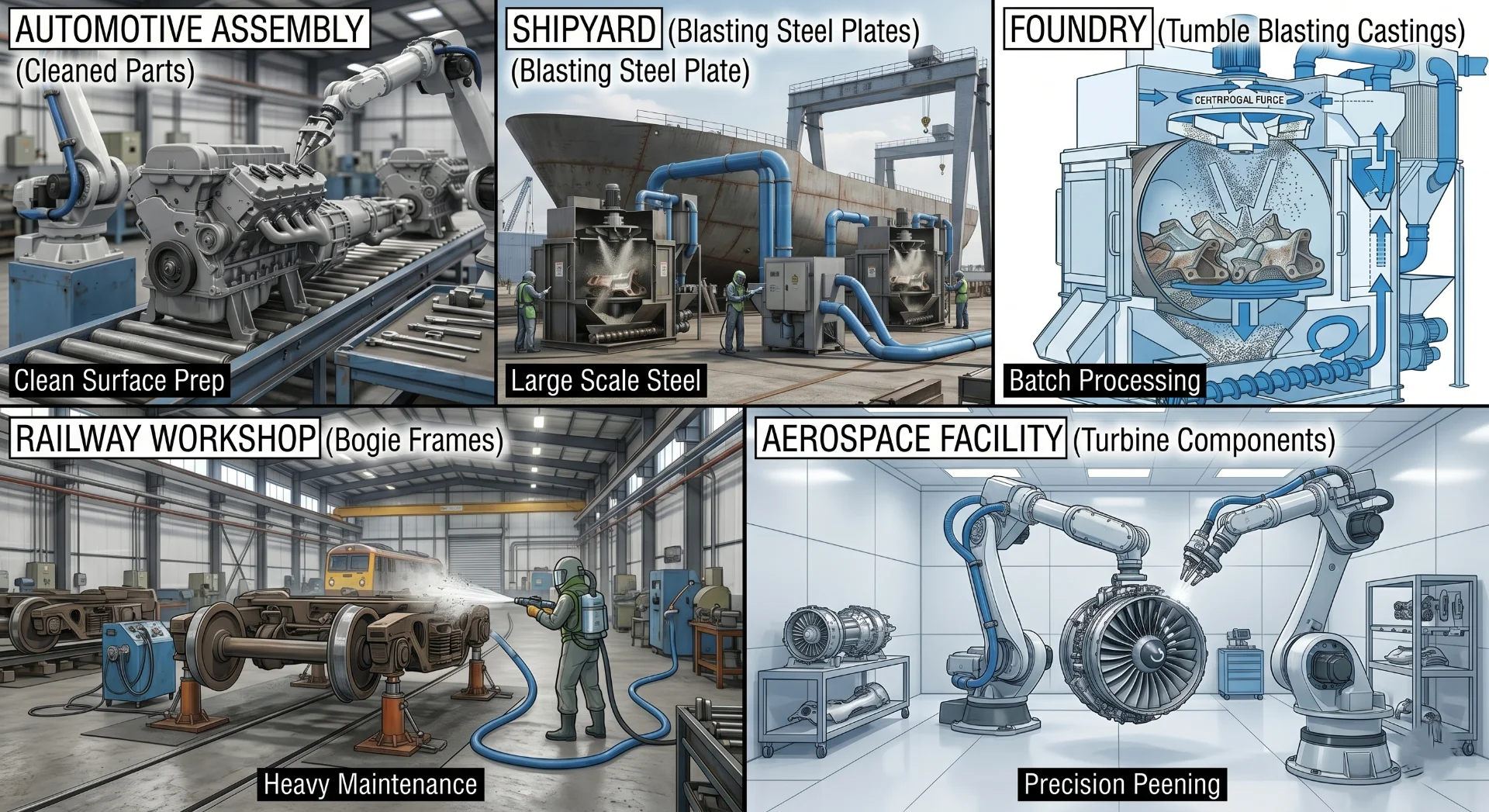
The automotive industry extensively uses shot blasting during the manufacturing of vehicle components. Engine parts, chassis components, suspension systems, wheels, gears, brake components, and various structural parts undergo shot blasting to improve surface quality and prepare them for coating or assembly operations.
Foundries are among the most common users of shot blasting equipment. Castings often emerge from moulds with sand residues, scale, and surface imperfections. Shot blasting effectively cleans castings and prepares them for machining, inspection, painting, or final assembly.
The aerospace industry relies on shot blasting for both cleaning and surface strengthening applications. Aircraft components, turbine parts, structural assemblies, and precision-engineered products often undergo blasting processes to achieve required surface characteristics and improve fatigue resistance.
Shipbuilding and marine engineering industries frequently use shot blasting to prepare steel plates, ship sections, marine structures, and offshore equipment. Because marine environments are highly corrosive, proper surface preparation is essential for ensuring long-lasting coating performance and corrosion protection.
Railway manufacturing is another major industry where shot blasting plays a crucial role. Railway coaches, locomotives, bogies, structural components, wheels, and rail infrastructure equipment require effective cleaning and preparation before coating and assembly.
Construction equipment manufacturers commonly use shot blasting during the production of excavators, loaders, cranes, bulldozers, and heavy machinery. The process removes contaminants and creates surfaces capable of supporting durable protective coatings.
The oil and gas industry uses shot blasting for pipelines, storage tanks, pressure vessels, drilling equipment, structural steel, and offshore platforms. Proper surface preparation helps ensure coating adhesion and corrosion resistance in demanding operating environments.
Heavy engineering industries rely on shot blasting for cleaning large fabricated structures, industrial machinery, pressure vessels, process equipment, and custom-engineered products. These components often require extensive surface preparation before finishing and installation.
Machinery manufacturing facilities use shot blasting for gears, machine frames, housings, fabricated assemblies, and industrial equipment. The process improves surface cleanliness and contributes to higher product quality and durability.
The power generation sector commonly utilizes shot blasting during the production and maintenance of turbines, boilers, structural supports, heat exchangers, and energy infrastructure components. Surface preparation helps maintain reliability and operational performance.
Mining equipment manufacturers also depend on shot blasting to prepare components exposed to severe operating conditions. Mining machinery, crushing equipment, structural assemblies, and wear-resistant components benefit from improved coating adhesion and corrosion protection.
Agricultural equipment manufacturers use shot blasting during the production of tractors, harvesters, implements, trailers, and farming machinery. Clean and properly prepared surfaces help ensure durable coatings capable of withstanding outdoor environments.
The defines and military sector frequently employs shot blasting for armoured vehicles, military equipment, structural components, weapon system parts, and specialized engineering products. Surface preparation plays an important role in maintaining durability and performance.
Steel service centers and metal processing facilities commonly use shot blasting for steel plates, sheets, pipes, bars, rods, and structural materials before fabrication or distribution. The process improves appearance and prepares materials for downstream manufacturing operations.
The infrastructure and bridge construction industry uses shot blasting to prepare structural steel components before painting and installation. Proper surface treatment helps maximize coating life and reduce long-term maintenance costs.
The wind energy sector relies on shot blasting for manufacturing wind turbine towers, structural supports, and associated components. Because these structures operate in challenging outdoor environments, effective surface preparation is critical for corrosion protection.
Storage tank manufacturers use shot blasting to clean internal and external tank surfaces before applying protective coatings. This helps improve corrosion resistance and extend equipment service life.
The pipeline manufacturing industry frequently utilizes shot blasting for both internal and external pipe surfaces. Proper cleaning ensures better coating adhesion and helps protect pipelines from corrosion during operation.
General manufacturing industries also represent a major application area for shot blasting. Components made from steel, cast iron, aluminium, and other materials often require cleaning, descaling, deburring, or surface preparation before further processing.
Many industries additionally use specialized forms of shot blasting such as shot peening, which improves fatigue resistance and mechanical performance of critical components. Aerospace, automotive, railway, and defines sectors commonly use this process for high-performance applications.
Modern shot blasting systems support these industries through advanced automation, abrasive recycling systems, energy-efficient blast wheels, automated material handling, process monitoring technologies, and high-performance dust collection equipment. These innovations help improve productivity while maintaining consistent surface treatment quality.
Routine maintenance remains important for ensuring reliable operation regardless of industry. Blast wheels, liners, abrasive recovery systems, dust collectors, separators, conveyors, and control systems should be inspected regularly to maintain efficiency and performance.
In the final paragraph, Shot Blasting is commonly used in industries such as steel fabrication, automotive manufacturing, foundries, aerospace production, shipbuilding, railway engineering, construction equipment manufacturing, oil and gas operations, heavy engineering, machinery production, power generation, mining equipment manufacturing, agriculture machinery production, defence manufacturing, bridge construction, wind energy, storage tank production, pipeline manufacturing, and general industrial fabrication. Its ability to deliver efficient surface cleaning and preparation makes it an essential process across modern industries.
Conclusion
Shot Blasting is widely used across numerous industries because it provides fast, effective, and reliable surface preparation. By removing contaminants, improving coating adhesion, enhancing durability, and supporting product quality, it helps manufacturers achieve superior results while improving efficiency and long-term performance.