In industrial manufacturing and processing environments where grinding, cutting, woodworking, cement production, mining, agricultural processing, powder handling, metal fabrication, and bulk material transfer operations generate large quantities of airborne dust and particulate contaminants, maintaining efficient dust collection and reliable filtration performance is essential for protecting worker health, improving workplace safety, maintaining cleaner operational conditions, and ensuring uninterrupted industrial production performance, and since 2-stage cyclone dust collectors operate continuously under demanding industrial conditions involving high airflow movement, abrasive particles, multi-stage dust separation, and heavy particulate loads, regular maintenance is necessary to maintain stable airflow, efficient dust separation, and long-term operational reliability, and while 2-stage cyclone dust collectors provide highly effective industrial dust control through sequential dust separation stages and centrifugal airflow technology, improper maintenance can result in airflow imbalance, reduced dust collection efficiency, excessive wear, operational blockage, and increased maintenance costs, and in the middle of maintaining reliable industrial dust control systems, the 2-Stage Cyclone Dust Collector requires regular inspection, hopper cleaning, airflow monitoring, wear inspection, and secondary filtration maintenance to ensure optimal long-term dust separation performance and industrial pollution control efficiency.
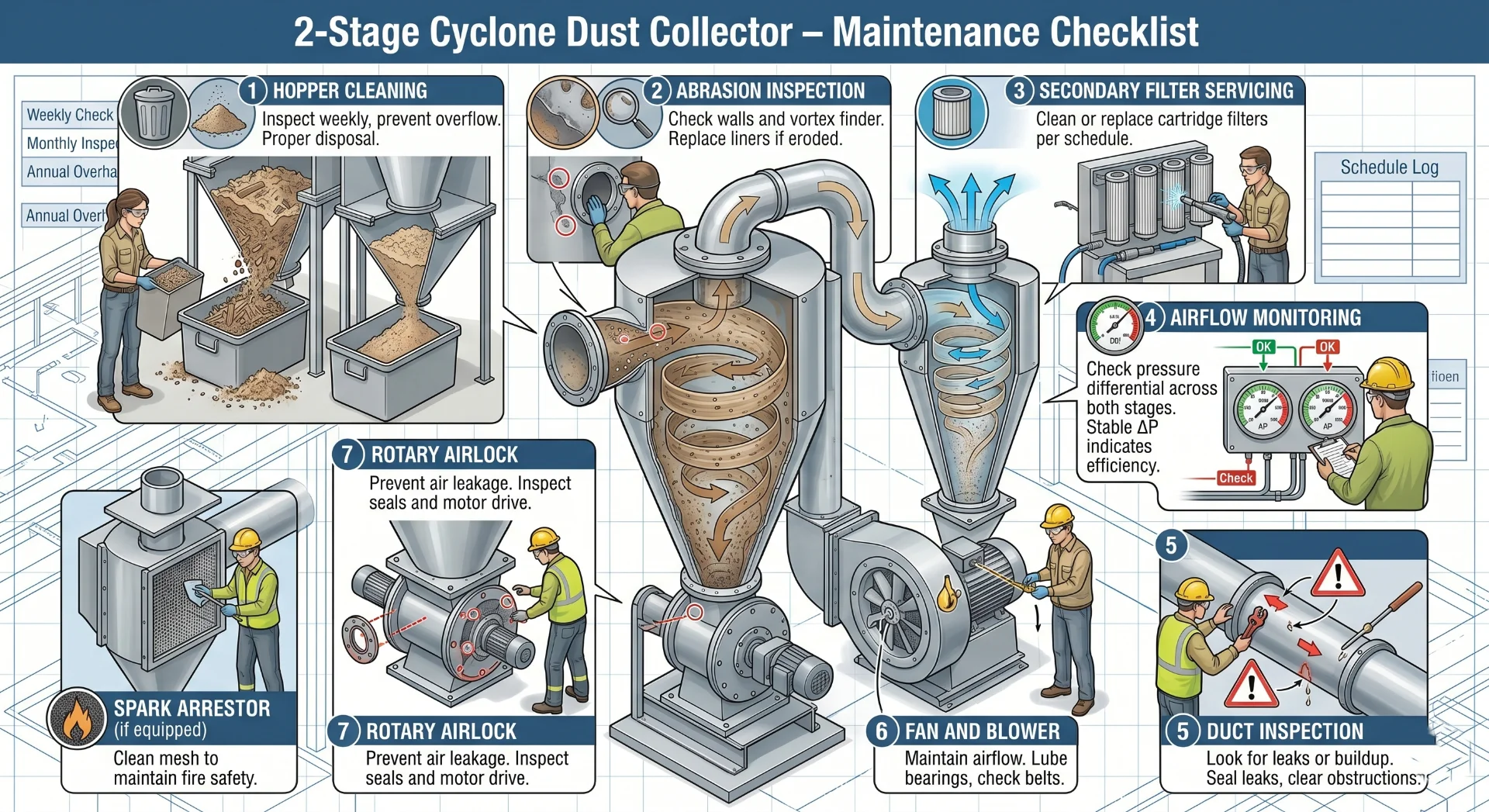
One of the most important maintenance activities for a 2-stage cyclone dust collector is regular inspection and cleaning of the dust collection hoppers because large quantities of separated dust particles accumulate continuously during industrial operation. Excessive dust build-up inside the hopper may restrict dust discharge and affect airflow performance if not removed properly. Hopper discharge systems such as rotary airlocks and dust disposal arrangements should also be inspected regularly to ensure continuous dust removal without airflow leakage. Airflow monitoring is another critical maintenance requirement because stable airflow velocity is essential for maintaining proper centrifugal force and efficient dust separation inside both cyclone stages. Airflow imbalance, duct blockage, or leakage may reduce dust collection efficiency and operational performance. Industrial blowers, exhaust fans, motors, belts, bearings, and airflow ducts should be inspected regularly for wear, vibration, imbalance, or airflow leakage during routine servicing. The cyclone chamber itself requires periodic inspection because abrasive dust particles such as cement residue, grinding particles, stone dust, and metal contaminants can cause internal wear over time. Abrasion-resistant liners, cyclone walls, and conical sections should be checked regularly for erosion, corrosion, cracks, or structural damage that could affect separation performance. One of the major maintenance requirements specific to 2-stage cyclone systems is inspection of the secondary filtration stage because the second stage is responsible for removing finer airborne contaminants after primary cyclone separation. Depending on system design, the secondary stage may include cartridge filters, bag filters, secondary cyclones, or fine particle separators that require regular cleaning and servicing. Filter bags or cartridge elements should be inspected for clogging, wear, or physical damage that may reduce airflow and filtration efficiency. Pressure monitoring is also important because increased pressure drop across the secondary filtration stage may indicate dust build-up, airflow restriction, or maintenance issues requiring immediate attention. Ducting systems connecting both stages should be inspected regularly for material build-up, airflow obstruction, leakage, or loose connections that could reduce dust separation performance. Electrical systems and automated controls should also be checked regularly because certain advanced systems may include airflow sensors, automated dust discharge systems, pressure monitoring controls, and safety monitoring equipment. Spark arrestors and explosion protection systems should be inspected carefully in industries handling combustible dust or hot particles to maintain operational safety. Proper sealing and gasket inspection are essential because air leakage inside the cyclone chamber or filtration housing can reduce suction efficiency and lower dust collection performance. Routine cleaning around the system helps prevent secondary dust accumulation and improves workplace safety. Lubrication of moving mechanical components such as rotary airlocks, motors, bearings, and fan assemblies helps maintain smooth and reliable operation during continuous industrial use. Maintenance schedules should be planned according to operational hours, dust load, particle abrasiveness, airflow volume, and industrial production conditions. Proper maintenance records and routine inspection programs help industries identify operational issues early and reduce unexpected downtime. Advanced 2-stage cyclone dust collectors may include multi-cyclone arrangements, automated dust discharge systems, airflow balancing controls, and secondary filtration monitoring systems that also require periodic servicing and calibration. Regular maintenance not only improves dust collection efficiency but also helps reduce energy consumption, equipment wear, operational downtime, and long-term maintenance costs. Proper maintenance including hopper cleaning, airflow inspection, wear monitoring, secondary filter servicing, fan maintenance, duct cleaning, and system inspection helps maintain reliable long-term industrial dust control performance. In the final paragraph, the 2-Stage Cyclone Dust Collector requires regular maintenance including hopper cleaning, airflow monitoring, abrasion inspection, secondary filtration servicing, fan maintenance, duct inspection, and pressure monitoring to ensure efficient dust separation, stable airflow performance, cleaner workplace air quality, reduced operational downtime, and reliable long-term industrial pollution control efficiency.
Conclusion
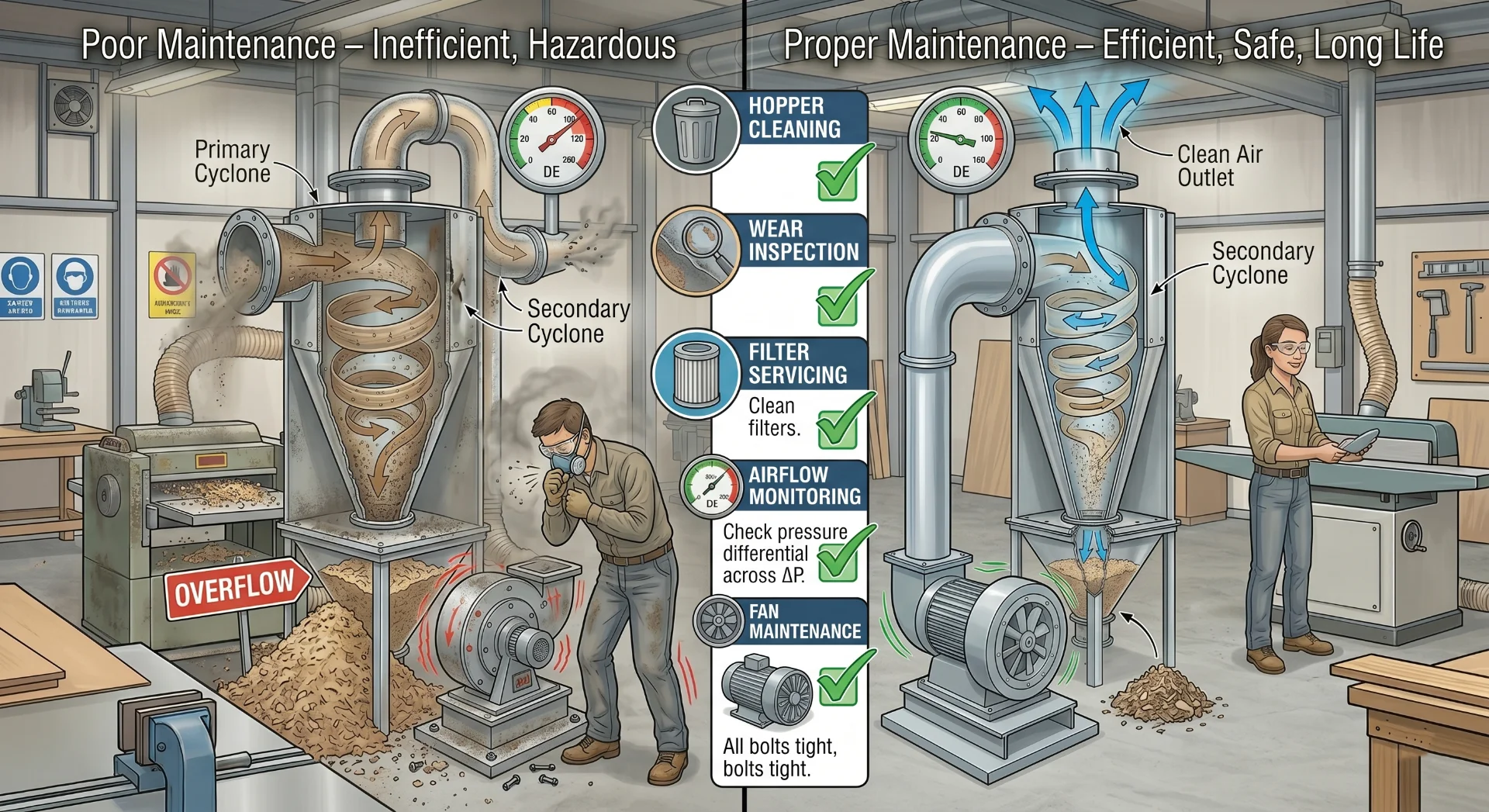
Proper maintenance of a 2-stage cyclone dust collector is essential for maintaining efficient dust separation, stable airflow performance, cleaner workplace air quality, reduced equipment wear, and reliable long-term industrial dust control performance.