In commercial environments where dust, dirt, powder residue, dry waste, fine particles, and lightweight debris are generated continuously during cleaning, maintenance, and daily operational activities, maintaining cleanliness and hygiene is essential for improving workplace safety, creating healthier indoor environments, protecting equipment, and ensuring professional working conditions, and since commercial spaces such as offices, hotels, shopping centres, hospitals, workshops, educational institutions, warehouses, and service facilities require efficient cleaning systems for regular maintenance, vacuum cleaning equipment designed for commercial use plays an important role in improving operational cleanliness and reducing manual cleaning effort, and among the widely used cleaning solutions for commercial applications, single-phase commercial vacuum cleaners are highly preferred because of their compact design, easy operation, reliable suction performance, and compatibility with standard electrical power systems, and in the middle of maintaining cleaner commercial environments and improving cleaning efficiency, the Single phase Commercial Vacuum Cleaner works as a commercial cleaning machine that uses single-phase electrical power and suction airflow technology to collect dust, dirt, dry waste, and fine particles from floors, equipment, carpets, and work areas efficiently.
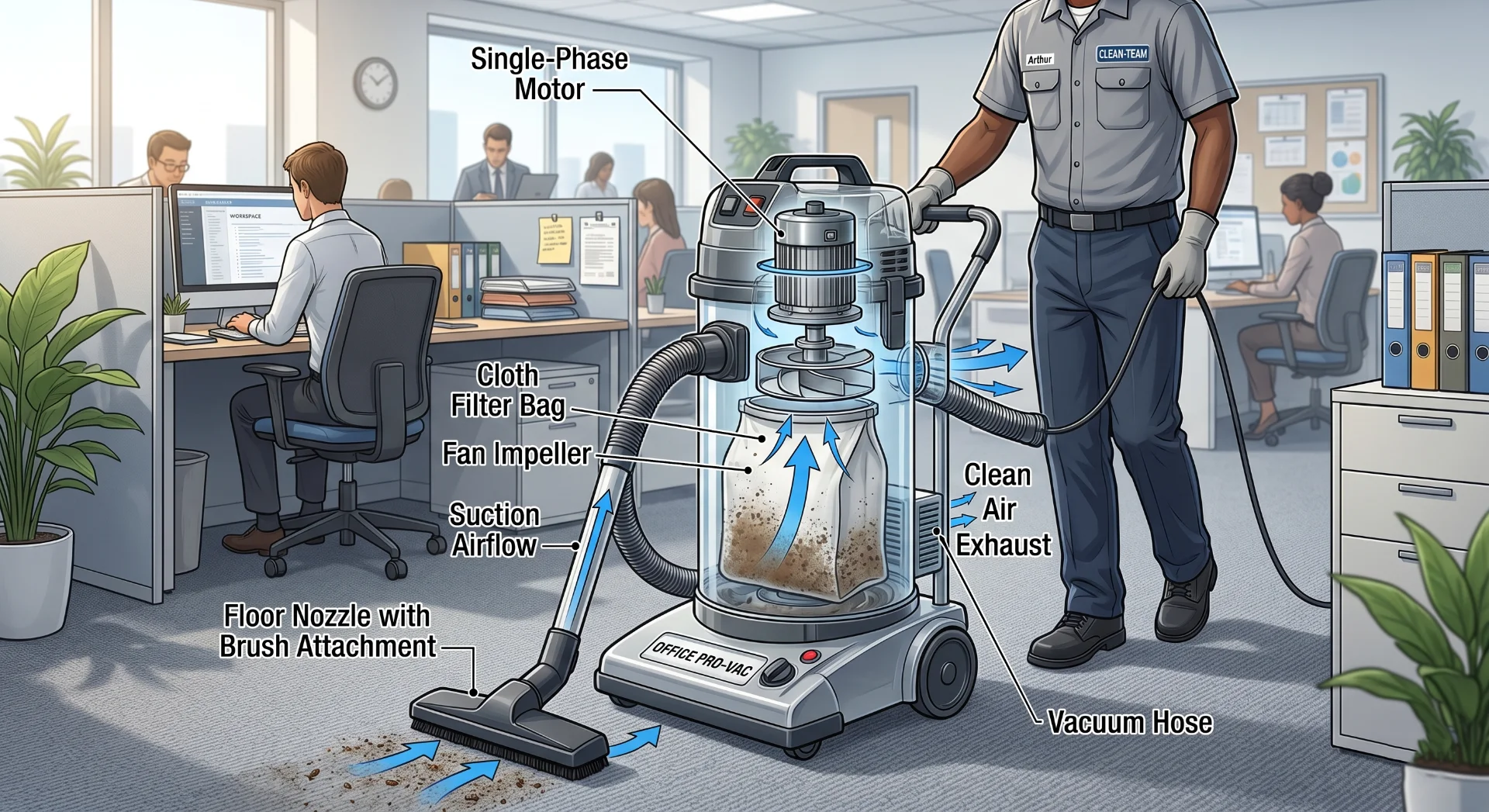
single-phase commercial vacuum cleaner is a cleaning machine designed for commercial and moderate-duty cleaning applications where reliable dust and dirt collection is required during daily cleaning operations.
The system operates using a standard single-phase electrical power supply commonly available in commercial buildings, offices, workshops, and service facilities.
The working principle of the vacuum cleaner is based on suction airflow generated by an electric motor installed inside the machine.
When the vacuum cleaner is switched on, the motor creates negative air pressure within the vacuum chamber, producing suction through connected hoses, pipes, and cleaning nozzles.
This suction airflow pulls dust, dirt, powder residue, lightweight debris, and fine particles into the vacuum system from floors, carpets, furniture, machinery surfaces, and operational workspaces.
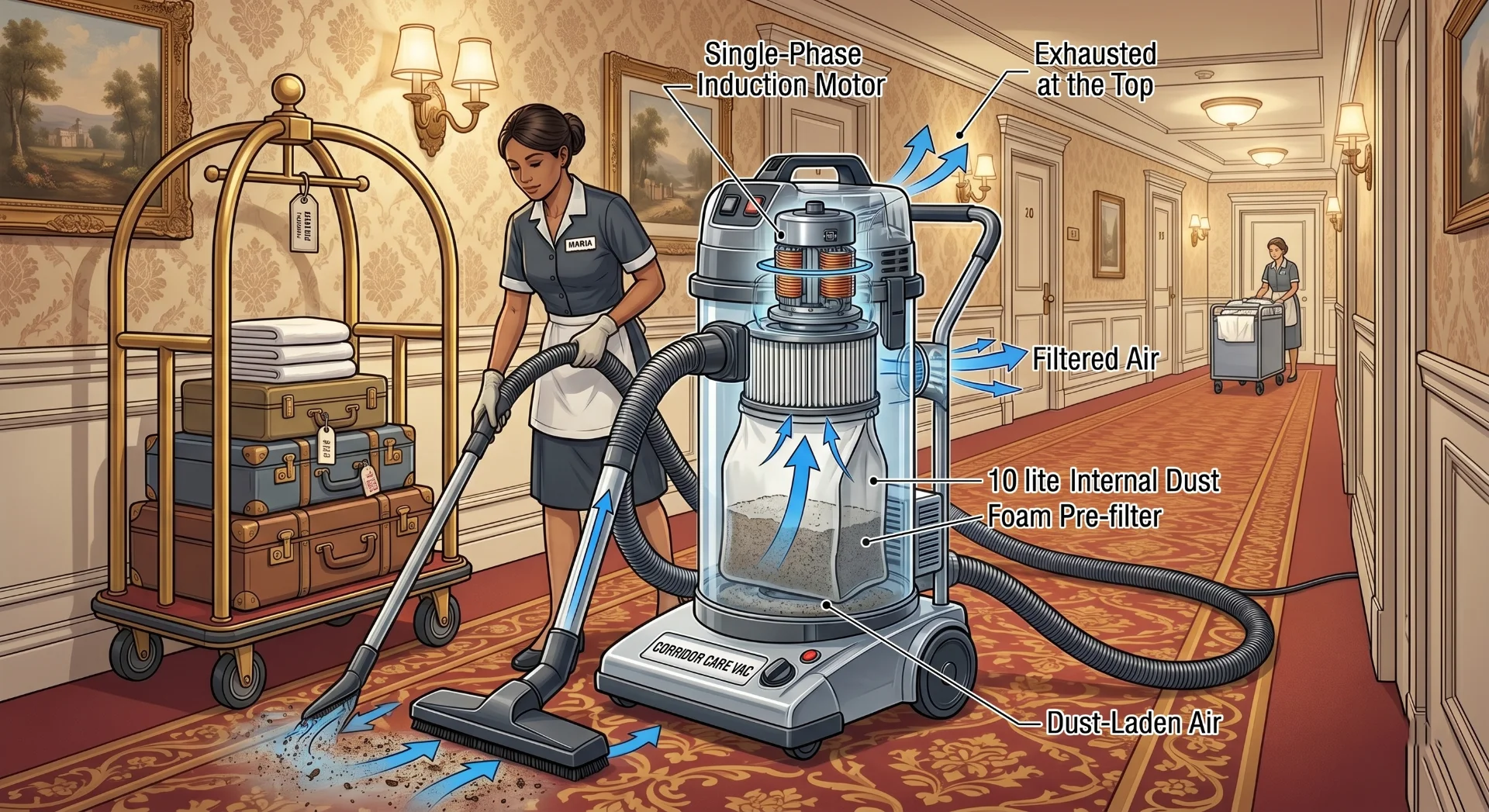
The contaminated air and collected material pass through internal filtration systems designed to separate solid particles from the airflow.
Different filtration arrangements such as cartridge filters, cloth filters, paper filters, foam filters, or HEPA filters may be used depending on the cleaning application and contaminant type.
The collected dust and waste material are stored inside collection containers, dust bags, or internal storage chambers for easy disposal after cleaning operations.
After filtration, cleaner air is released through the exhaust system while dust and contaminants remain trapped inside the filtration unit.
One of the major advantages of a single-phase commercial vacuum cleaner is its compatibility with standard electrical systems, allowing easy installation and operation without requiring industrial electrical infrastructure.
The systems are generally lightweight, portable, and easy to move across different cleaning areas inside commercial facilities.
Single-phase commercial vacuum cleaners are highly effective for handling dry dust, lightweight debris, powder residue, and routine commercial cleaning applications.
The systems are widely used in offices, hotels, hospitals, schools, retail stores, warehouses, workshops, showrooms, service centres, and commercial buildings.
Some models may also support wet and dry cleaning operations depending on operational requirements.
Compact machine design allows convenient cleaning in narrow spaces, furniture areas, corridors, staircases, and commercial workstations.
Improved workplace cleanliness helps create safer and more hygienic environments for employees, customers, and visitors.
Different nozzle attachments and accessories allow the vacuum cleaner to perform floor cleaning, carpet cleaning, upholstery cleaning, and equipment surface cleaning efficiently.
Certain commercial vacuum cleaners may include advanced filtration systems for improved dust control and cleaner indoor air quality.
Routine maintenance includes filter cleaning or replacement, motor inspection, hose checking, dust container cleaning, and airflow monitoring to maintain reliable cleaning performance and long-term operational efficiency.
Properly maintained vacuum systems help improve cleaning productivity and reduce manual cleaning effort during regular commercial maintenance activities.
In the final paragraph, the Single phase Commercial Vacuum Cleaner works by using single-phase motor-driven suction airflow and filtration systems to collect dust, dirt, powder residue, and commercial waste efficiently, helping businesses maintain cleaner workplaces, improved hygiene, better indoor air quality, and reliable day-to-day cleaning performance in commercial environments.
Conclusion
A single-phase commercial vacuum cleaner is an efficient and reliable cleaning system designed for commercial environments, providing effective dust collection, easy operation, improved workplace cleanliness, and convenient maintenance for daily cleaning applications.